Vehicle Inventory Ad Feed Pipeline Case Study
One inventory source feeding Google and Facebook advertising
A dealership group has inventory in one system and advertising in several others. Each ad platform wants vehicles in its own format, and the inventory changes every day.
I built a Go ETL pipeline and API at World Car Auto Group that turns the inventory data into feeds for Google and Facebook. It is still used for inventory marketing.
The problem
Ads for vehicles are only useful when the vehicle is real, in stock, and priced correctly. Keeping that true by hand across platforms does not work, and mistakes cost ad money and customer trust.
The business also needed more than uploads. It needed custom ad feeds, organic vehicle listings, and pages that matched what the ad had promised.
Constraints
- Inventory arrived as automotive CSV feeds.
- Each platform had its own format and rules.
- Feeds had to be split by brand and unique identifier.
- The data changed constantly.
What I built
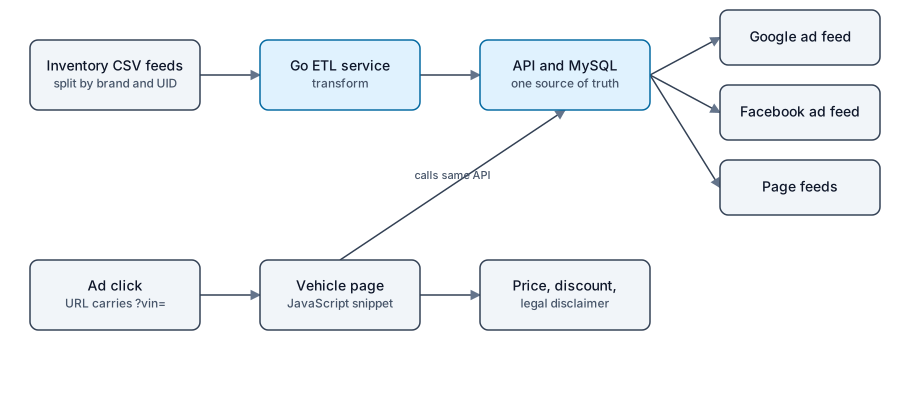
The pipeline on top, and the vehicle page script on the bottom reading from the same API.
The Go ETL pipeline and API
A Go service reads the automotive CSV feeds, transforms the data, and serves it through an API backed by MySQL. The feeds are split by brand and unique identifier, so each brand’s inventory can go to the right ad account.
The same data powers custom ad feeds for Google and Facebook, and it can generate page feeds.
Organic vehicle listing ads
The feed originally produced organic vehicle listing ads for the dealership’s Google Business Profile. Google has since ended that program, so that part is in the past.
A script that matched the page to the ad
Some ads carried custom discount and finance rates. Each ad click sent the visitor to the dealership site with a VIN in the URL.
A JavaScript snippet on the vehicle detail page read the VIN, called the same API that built the ad feed, and updated the on-page price and discount. It also added the required legal disclaimer to the top of the page.
The script was retired shortly after COVID, when the business stopped offering those discounts. That was a business decision, not a technical one. I have no results data for it.
Why it was built this way
The point was one source of truth. When the ad, the feed, and the landing page all read from the same API, they cannot disagree.
I wrote about the design thinking behind the page script in Match the Landing Page to the Ad.
Where it came from
This work started with a 3.5 GB Texas sold-vehicle dataset that I filtered with Python into reporting data. That first data problem led me from marketing into software, and the feed pipeline grew from the same instinct.
What this does not claim
The feed supports advertising and listing feeds. It is not an SEO page system, and I do not describe it as one.
Related
The data pipelines and automation and API integrations services draw on this project.
Pipeline proof
Data pipeline and automation facts.
- Dataset
- 3.5 GB
- Texas sold-vehicle dataset filtered with Python into reporting data.
- Ad feeds
- Google and Facebook
- Go pipeline still used for inventory marketing.
- Ad budgets
- $10K - $40K monthly
- Across all 13 stores at World Car.